More About Me
I am a NSF postdoctoral fellow in Dr. Shermin de Silva's Human-Nature Lab at the University of California San Diego. I use long-term observations of Asian elephant populations to ask questions about the factors underlying the evolution of social structure. My main research interest is investigating how animal social behaviors affect persistence of wildlife populations on human-dominated landscapes.
I earned my PhD in the School of Biological Sciences at the University of Nebraska-Lincoln (UNL), co-advised by Dr. Shizuka and Dr. Jeffrey Stevens. I was supported by a National Science Foundation Research Traineeship (NRT), which provided a foundation in resilience and complexity theory in social-ecological systems. My dissertation focused on 1) how social learning affected responses to novel food resources, 2) factors affecting long-term spatial and social fidelity (now published in PNAS), and 3) how demographic turnover affected the structure and stability of social communities in golden-crowned sparrows (Zonotrichia atricapilla) in Santa Cruz, California.
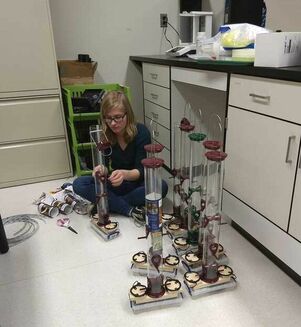
Prior to accepting a PhD position at UNL, I worked for Dr. Shizuka, managing a RFID (Radio Frequency Identification) bird feeder project at the Pioneers Park Nature Center in Lincoln, Nebraska. This ongoing project uses feeders outfitted with RFID antennas and data loggers (pictured top left!) to study the winter ecology of birds that participate in mixed-species flocks. I built a weather station controlled by an Arduino Uno to collect fine-scale weather data on-site in conjunction with the RFID feeders. Using the weather station and RFID feeders, I asked questions about the effects of weather on feeding rates of RFID-tagged birds. Together with my co-authors, we also investigated whether birds with similar foraging activity are more connected in a social network, and asked which had a stronger effect: physiological factors or social connections. Interestingly, social relationships had stronger apparent effects on foraging behavior than temperature (Madsen et al. 2021)!
I earned my PhD in the School of Biological Sciences at the University of Nebraska-Lincoln (UNL), co-advised by Dr. Shizuka and Dr. Jeffrey Stevens. I was supported by a National Science Foundation Research Traineeship (NRT), which provided a foundation in resilience and complexity theory in social-ecological systems. My dissertation focused on 1) how social learning affected responses to novel food resources, 2) factors affecting long-term spatial and social fidelity (now published in PNAS), and 3) how demographic turnover affected the structure and stability of social communities in golden-crowned sparrows (Zonotrichia atricapilla) in Santa Cruz, California.
Prior to accepting a PhD position at UNL, I worked for Dr. Shizuka, managing a RFID (Radio Frequency Identification) bird feeder project at the Pioneers Park Nature Center in Lincoln, Nebraska. This ongoing project uses feeders outfitted with RFID antennas and data loggers (pictured top left!) to study the winter ecology of birds that participate in mixed-species flocks. I built a weather station controlled by an Arduino Uno to collect fine-scale weather data on-site in conjunction with the RFID feeders. Using the weather station and RFID feeders, I asked questions about the effects of weather on feeding rates of RFID-tagged birds. Together with my co-authors, we also investigated whether birds with similar foraging activity are more connected in a social network, and asked which had a stronger effect: physiological factors or social connections. Interestingly, social relationships had stronger apparent effects on foraging behavior than temperature (Madsen et al. 2021)!
In my spare time, I love to cook, paint, draw animals, and sing show tunes. Below are some of my final illustration pieces from a Science Illustration course I took at UNL!